The very first step in planning the construction of a new home is the construction budget. Developing a preliminary budget spells out the allocation of funds for your project in broad terms.
Knowing your spending limits and developing a home building budget will go a long way towards keeping you out of financial trouble on your project, especially during the preparation of your plans and specifications. Your final "working" budget will be developed when you complete the cost estimating process.
Here's an all-too-typical scenario provide by O and S Remodeling in PV in Arizona.
A family decides to
build a new home in Scottsdale, They spend months (or years) collecting photos and magazine clippings of features and products they want to include. Armed with these and sketches of ideas they have about room layout, front elevations, and so forth, they hire an architect to design their dream home.
The plans are finished and they take them to a builder or supplier to get a cost estimate, and guess what? The home costs out at three times what they can afford. So now they must go through the gut-wrenching process of cutting room sizes and other features to get the costs down.
Before they really start, they are already dealing with a watered-down version of what they thought they wanted.
Here's a better way.
1. Determine how much you can (want to?) spend.
2. Establish square foot costs in your area.
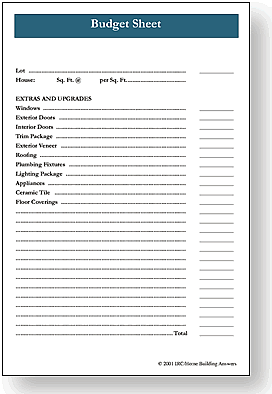
3. Complete a preliminary Budget Sheet (we have provided one). Click here.
4. Adjust square footage, extras, and upgrades to meet your spending limit.
Determine Your Cost Limit
Developing a budget for a new home starts with deciding how expensive a home do you wish to build? Tim with Investment Properties asks a better questions, how expensive a home can you afford to build? If you are like most people, you want the most home you can afford.
On the other hand, you may be able to afford much more home than you really want or need. Everyone's situation, of course, is unique. Most people already have some suspicion about how much they want or can afford to spend.
If you want as much as you can afford, but don't know what that figure is, start from the end and work backwards.
In other words, determine what cash you can or are willing to put into your home and how much you can afford in monthly payments to cover whatever money you need to borrow.
Qualifying Formulas
Figuring out how much home you can afford isn't all that difficult. Lenders and real estate agents do it every day. A "lender" may be a bank, a savings and loan, an insurance company, a credit union, a relative, or some other source.
Lenders use qualifying formulas to determine how much you can afford to pay each month. The formulas will vary from bank to bank but generally they compare your income to your debt payments.
If you take your monthly payments (house payment, car loan, charge cards, etc. - not utilities, food, entertainment) and divide it by the sum of all your monthly income, the number you come up with should not exceed .33 to .36, depending on the percentage of the cost of the home you are planning to borrow (80%, 90%, 95%?).
Another typical guideline is that the total monthly house payment should not exceed 25% of your stable monthly income.
PITI
The monthly house payment used in these qualifying formulas consists of four items: principal, interest, taxes and insurance (PITI). A portion of the monthly house payment will go towards reducing the principal (the amount of money originally borrowed).A portion will also pay the previous month's interest on what you still owe. Below is a brief discussion of the other two items.
TAXES
In addition to principal and interest, you will also have to pay property taxes. These are levied by the city, the county, and in some cases the local school board. The tax bill is due each year. It can amount to a hefty sum, depending on where you live.
If you do not pay your property taxes, the government can seize and sell your land to get its money. The people who loaned you the money to buy the home are also looking to the home itself as the ultimate security to guarantee repayment.
If you didn't pay your taxes, and the government foreclosed (seize and sell), how could the bank get their money back? To protect their interests, most lenders will estimate the annual tax bill and make you pay 1/12 of that amount each month along with your principal and interest.
They accumulate this money in a special account called an "escrow" account. At the end of the year, the lender pays the property tax due on your home out of the funds that are in this escrow account. This assures the lender that the taxes are paid.
INSURANCE
Lending institutions also worry about the possibility of anything happening to the home that would damage or destroy its value and thereby jeopardize the collateral securing their investment. Such things may include a fire, a falling tree, or a tornado.
Most lenders will require you to carry a home insurance policy to guarantee that funds will be available to repair accidental damage to the home. Many lenders will also require payment of the premium for this insurance to be made in a fashion similar to the tax escrow described in the previous paragraph.
These four items - principal, interest, taxes, and insurance, are the items considered in most formulas that are used to determine how much house you can afford. In addition to PITI, some formulas also use maintenance of the home - repair of worn or broken items, repainting, etc., and income taxes.
Working Backwards
!By knowing your income, your monthly debt obligations, and how much cash you are going to put up, a lender or real estate agent can use their knowledge of current insurance rates, propert taxes, and standard amortization (payment) tables to help you work backwards to find out how much home you can afford (total price).
And they can usually do it in a matter of minutes. A good online resource for determining how much you can afford is www.nolo.com. In their search feature, type, "qualifying for a home loan."
BALL PARK FIGURES
The following table may give you some "ball park" feel about the relationship between interest rates, mortgage amounts, monthly payments, and annual income needed. A 30-year loan is assumed in each case. The monthly taxes and insurance are estimated at 12% of the monthly principal and interest payment.
| RATE |
AMOUNT |
P&I |
T&I (@12%) |
PYMT |
INCOME |
| |
|
|
|
|
|
| 8.50% |
250,000 |
1,922 |
231 |
2,153 |
103,500 |
| 8.00% |
250,000 |
1,834 |
220 |
2,054 |
99,000 |
| 7.50% |
250,000 |
1,748 |
210 |
1,958 |
94,000 |
| 7.00% |
250,000 |
1,663 |
200 |
1,863 |
89,500 |
| |
|
|
|
|
|
| 8.50% |
300,000 |
2,307 |
277 |
2,584 |
124,000 |
| 8.00% |
300,000 |
2,201 |
264 |
2,465 |
118,500 |
| 7.50% |
300,000 |
2,098 |
252 |
2,350 |
113,000 |
| 7.00% |
300,000 |
1,996 |
240 |
2,236 |
107,500 |
| |
|
|
|
|
|
| 8.50% |
350,000 |
2,691 |
323 |
3,014 |
144,500 |
| 8.00% |
350,000 |
2,568 |
308 |
2,876 |
138,000 |
| 7.50% |
350,000 |
2,447 |
294 |
2,741 |
131,500 |
| 7.00% |
350,000 |
2,329 |
279 |
2,608 |
125,000 |
Let The Professionals Do The Work!
If all this sounds complicated, it isn't. Let's put it in perspective. It can all be done in an afternoon on the phone or in a few minutes online. You know what your income is. Sit down and add up your monthly payments for long-term obligations and decide how much cash you may be willing to put into your new home.
Then pick up the phone and call a mortgage banker, credit union, or Realtor.Tell them: I've got $______ in cash. My monthly gross income is $______. My monthly payments for long-term obligations are $_________. How much house can I afford? It's that simple.
Including The Builder's Profit
Remember that as the contractor, you will also have the builder's profit to work with. So you can have that much more home. Let's say you've been told you can afford a $300,000 home. Assuming a 15% to 20% builder's profit, that would put you in the $345,000 to $360,000 price range.
Square Foot Costs
The next step in developing a budget for a new home is estimating the square foot costs of tract homes in your area. This may seem like a mystery. Why in the world do we want square foot costs for tract homes?
The reason will become clear very shortly. So how do I get these square foot costs? Well, some detective work and some "guesstimating" are required. Here's how to start.
First visit some under-construction subdivisions in the area where you intend to build and find a home that is similar in size and quality to the one you will build. We'll call this our "comparison home." Get the size of the home (in square feet) and the sales price. Both of these will be available from a sales agent.
Note: square footages generally refer to HEATED areas (unheated garages and basements will not be included) and will be measured from outside wall to outside wall.
Next you want to subtract the cost of the lot and the builder's overhead and profit to get at the actual cost of construction. Here is where the "guesstimating" comes in.
In a typical subdivision, national statistics indicate a lot value of about 25% of the value of the home. We like to be conservative and use a 20% figure. Note that we said a TYPICAL subdivision.
Obviously if you're dealing with ocean-front property, the lot costs would be much higher. You'll just have to use your best judgment here. You can also look around and see what other similar lots are selling for.Keep in mind that the builder of the subdivision probably paid less since he bought several lots, or even raw land. So you may want to lower the lot costs you find a little to more reasonably reflect what the builder actually has in the home you are using for comparison.
For the builder's overhead and profit we like to use a conservative 15% figure. It could be much higher, but being conservative here will help you stay within your construction budget later.
So what do we have? The price of the "comparison home" less 20% lot cost, less 15% overhead and profit. Which is the same as price less 35%. Which is the same mathematically as price times .65!
Divide that figure by the total heated square footage and you get a pretty good approximation of the COST PER SQUARE FOOT of a home similar to the one you want to build.
The formula is(Price x .65) ÷ total heated sq ft = cost per square foot
Is this totally accurate? No! Is it better than a total guess? Yes! Square foot costs are usually used only for comparison of housing costs between different areas of the country. Or for getting a feel about the quality of features and finishes in a home. For example, a home that costs over $200 a square foot is obviously much nicer than a similar sized home that costs $100 per square foot.
Also, consider this. A hypothetical home with outside dimensions of 40' x 50' has an area of 2,000 Sq.Ft. (square feet). The total length of its exterior walls is 180 linear feet (40+40+50+50). Another home has outside dimensions of 25' x 80". Its area is also 2,000 Sq.Ft. But the total of its outside walls is 210 linear feet!
If you assume (rightly) that building outside walls has an associated cost, then the second home has a more expensive outside wall, all else being equal.
The point is that using square foot costs is only a rough approximation. But starting with a "comparison home" that is similar in size and finish to the one you plan to build will provide an adequate basis for your budgeting.
Remember, a budget for a new home is a planning guide! Hard figures will come when the design is finished and a cost estimate is done from the actual labor and materials "takeoff."
Filling Out The Home Building Budget Sheet
The next step in developing your preliminary budget is deciding how your new home will differ from the "comparison home" and what impact your changes will have on the costs.That's where the Budget Sheet comes in.
Here's how to fill it in.
Most of you already own a lot. If so, fill in what you paid for it. If not, put down what you think you will pay for the lot you want.
Next fill in the approximate size in square feet you anticipate building and the cost per square foot of the "comparison home" you calculated above. Multiplying these together gives you a "base cost" (before changes) for your new home.Finally you need to make decisions as to how your home will be different from the "comparison home." Will you use a better window?
Nicer cabinets? Will you upgrade the appliances? Have fancier light fixtures? If so, get suppliers to help you arrive at generous estimates as to how much such upgrades (or downgrades) will cost. Plug in all these figures and total it all up. Is it more than you had intended (or can afford) to spend? If so, where can you cut?
Adjustments
More common than not, homeowners find themselves at a roadblock, whether it's material on back-order, building permits are delayed to be approved or even unexpected costs for change orders. Home Titan does a perfect job in walking the reader through important and easily overlooked steps when building a new construction or a home improvement remodel.
- Owner of Construction Management Software
Adjust square footage, extras, and upgrades to meet your spending limit. By repeatedly going through this process, you will arrive at a budget that works for you.
Then when you get your plans back from the architect, they will cost out at a figure that is within your BUDGET!
Being Realistic
If this is your first home, a word of caution. Be realistic. Don't fall into the trap of having "champagne tastes on a beer budget." On the other hand, you may find that you can afford more than you really want or need. That's a nice position to be in. If that's the case, build just what you want, and put your builder's profit to work for you in other ways!
OK! You have developoed a budget for a new home. Next step (if you haven't already done it) is to Find and Purchase Your Lot. Ready?


